


Every year on March 14, people around the world celebrate Pi Day, a special day dedicated to the mathematical constant π. From classroom activities to public events, the day encourages students and scientists alike to appreciate the beauty and importance of mathematics.
 1. What is Pi Day?
Pi Day is celebrated on March 14 because the date, written as 3/14, matches the first three digits of π. Pi is a mathematical constant that describes the relationship between a circle’s circumference and its diameter.
Besides March 14, there are a few other dates people use to celebrate π. For example, July 22 is known as Pi Approximation Day, since the fraction 22/7 is a common approximation of π. Some people also celebrate on June 28, because it represents 2π, a value that appears frequently in mathematics and physics.
2. Why is Pi important?
Pi is used in many areas of mathematics, science, and engineering. It helps us calculate things like the circumference and area of circles, and it also appears in many formulas in physics and geometry.
 3. History of Pi Day.
Pi Day was first celebrated in 1988 by physicist Larry Shaw at the Exploratorium in San Francisco. In 2009, the United States officially recognized Pi Day as a national celebration of mathematics.
In 2014, some people celebrated the entire month of March as “Pi Month.” The following year, March 14, 2015, was known as “Super Pi Day.” This date was special because it could be written as 3/14/15, matching the first five digits of π. At 9:26:53, the date and time together represented the first ten digits of π. At that exact moment—sometimes called the “Pi Instant”—the time matched even more digits of π.
4. How do people celebrate Pi Day?
The International Day of Mathematics was established by UNESCO. Because March 14 is both Pi Day and the International Day of Mathematics, there is an official theme each year.
Below are the themes from the past five years: 2021 – Mathematics for a Better World; 2022 – Mathematics Unites; 2023 – Mathematics for Everyone; 2024 – Playing with Math; 2025 – Mathematics, Art, and Creativity. This year (2026) the theme is Mathematics and Hope.
The purpose of these themes is to help people realize that mathematics is not just about formulas and calculations, but is also closely connected to everyday life, art, and society.
 5. Why does Pi Day matter?
Pi Day is not only about mathematics; it also encourages curiosity, creativity, and a greater appreciation for science.
6. What does a NIS teacher think about Pi Day?
Our math teacher, Mr. Zhang, shared his thoughts about this holiday: This is a fascinating date, because π is truly a remarkable number—beautiful and almost unbelievable. For thousands of years, people believed that everything in the world was created by gods and that everything followed fixed rules and patterns. But when the first person discovered π, things became different. It was the first non-repeating infinite decimal people had ever found.
Many people believe that if humanity were ever able to calculate the very end of π, many mysteries of the world might finally be answered.
When Mr. Zhang was studying at university in the United States, the school would celebrate Pi Day every year. People would draw a huge circle on the field, and professors would ask students to measure the circle’s circumference and diameter by walking along it with their steps. Then they would calculate the ratio between the circumference and the diameter, and the number they got was always around 3.1 and something more.
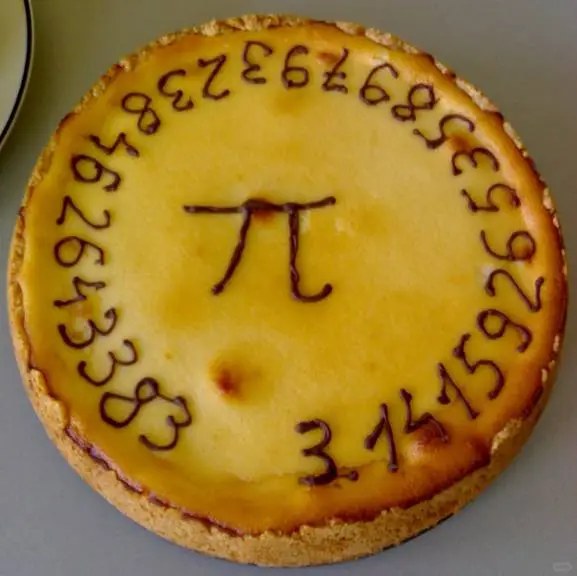
At the same time, if you took part in Pi Day celebrations that day, you could also receive a free pie.